By Alex Gibson
I stand in front of the grill, a sublime concoction of savory wafts of hissing proteins filling the air. I’m in a trance-like state as a light, cool breeze sweeps over the tops of trees, almost making them dance. The breeze makes my shirt move as if it was alive. The smoke from the grill stings my eyes, causing me to blink hard and snap out of the trance that was holding me captive. My eyes well with tears, reacting to the smoke. I turn over pieces of sizzling chicken one by one, using the ancient tongs with faded, wooden handles that I’d seen my father use a myriad of times. It’s all legs, thighs and a few wings. A drumstick drips like a leaky faucet, dripping crimson, red blood that disappears into the orangish, red flame.
What am I doing?
Why am I barbecuing right now?
Oh, right. It’s Juneteenth.
My “first” Juneteenth.
I didn’t know what Juneteenth was until I was in my late teenage years. I had never celebrated it before, but had celebrated Independence Day countless times. I can’t speak for all Black people because we’re not a monolith, but I know for many of us, Juneteenth can be a very confusing holiday.
“I acknowledge it, but I didn’t celebrate it because I just didn’t know how,” High Point University graduate student Kaitlyn Graham said. “I mean what are we even supposed to do?”
I have mixed feelings about Juneteenth. For years, I ignorantly celebrated the Fourth of July, thinking it applied to me and represented my freedom too. But that didn’t apply to all Americans.
And now, I just feel silly.
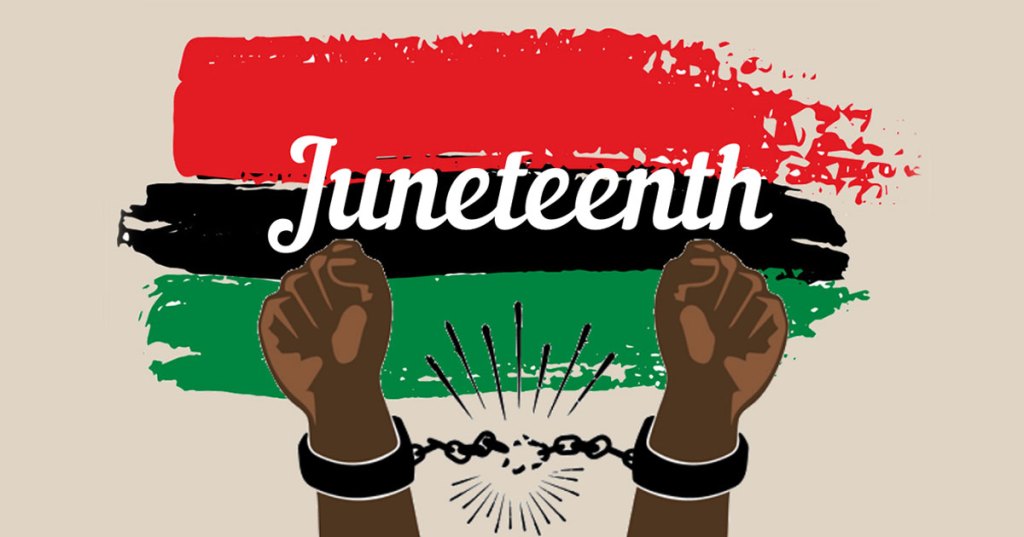
Juneteenth is a federal holiday in the United States celebrating the emancipation of African-American slaves.
But, slavery didn’t end on Juneteenth.
According to NPR, on June 19, 1865, Maj. Gen. Gordon Granger, who had fought for the Union, travelled to Galveston, Texas, to deliver an important message that the war (Civil War) was over, the Union had won, and it now had the manpower to enforce the end of slavery.
The message came two months after the end of the Civil War. And even though President Abraham Lincoln already signed the Emancipation Proclamation, many enslaved Black people still weren’t free. And of course, their white masters had no incentive to tell them.
Celebrating Juneteenth felt like I was celebrating the Fourth of July, just two weeks earlier than usual. It was nice to hear the fireworks. The fireworks were deafening, like kernels of popcorn in a microwave, popping as they discovered their true form. Some were scattered, while others consecutively exploded the rhythmic cadence of a marching band. I could imagine the fireworks fighting one another for space in the sky, and they were right outside, lighting up the night sky. To my knowledge, this was the first time I heard fireworks on Juneteenth, or maybe I had just never paid attention. And I absolutely hated hearing fireworks on the Fourth of July for hours on end.
I can’t count how many times I’ve been told about how America was “discovered,” but never about Ron Stallworth, the Black police officer who infiltrated the KKK. Or how Central Park used to be a thriving Black neighborhood called Seneca Village until it became an inconvenience. Or about Madam C.J. Walker, the first female self-made millionaire in America.
It makes you wonder. Why did we rarely, if ever, hear about great, Black American heroes, inventors and patriots?
Why didn’t I know what Juneteenth was until my late teenage years?
Why had I not learned about it in school?
Why hadn’t a single teacher told me what it was?
“The only reason I found out was because of social media,” Graham said. “I was 16ish when I found out about it.”
Unsurprisingly to me, but maybe surprising to others, Juneteenth only just became a holiday on June 17, 2021; it only took 150 plus years. I like the idea of Juneteenth. But, when it became a federal holiday, it almost felt like a stunt. A masquerade. A masquerade designed to appease. To pacify.
Almost like saying, “Here’s your silly, little holiday. Happy now? Now shut up and let’s get back to the originally scheduled programming.”
I feel the same way about Black History Month. People talk about the contributions of Blacks for one month, a minute a day and then forget about them the rest of the year.
That’s 28 out of 365.
Black history is American history. People shouldn’t have to be reminded to celebrate the achievements of Black Americans. They’re Americans. They’re part of American history.
In school, you only learn about Black history in February. At least that was my experience. But, when you think about it, it’s disrespectful to relegate Black history to a mere month.
Twenty-eight days. The shortest month of the year.
For some, I guess, the intention and thinking behind the idea is positive.
And, it is still recognition.
Should I just be grateful?
I don’t mean to sound cynical. It is nice to have that acknowledgement because Black history is typically overlooked, unappreciated and minimized.
I celebrated the Fourth of July many times growing up, each year a little less festive than the last until it wasn’t really a celebration but a formality, like going through the motions. As you get older, and your ignorance and innocence wanes, holidays get watered down and don’t mean as much as they once did. At least that’s what happened for me. So how does one celebrate a holiday for the first time? There is no model of the right way. It was all new to me.
I wonder how I would’ve celebrated Juneteenth when I was a little, bright-eyed kid, standing by the grill looking up at my father barbecuing while he smiled down at me. I wonder how prideful I would’ve been at that age. I wonder how I’d be different today, if at all. And I hope that maybe, just maybe, I’ll be able to reconnect with that innocent, bright-eyed, little boy one day.
Anyways, happy Juneteenth.
Alex Gibson is a senior at High Point University majoring in Journalism and minoring in Athletic Coaching. For contact inquiries, please email agibson2@highpoint.edu.
 NewsPoint Network