By Ben Membrino
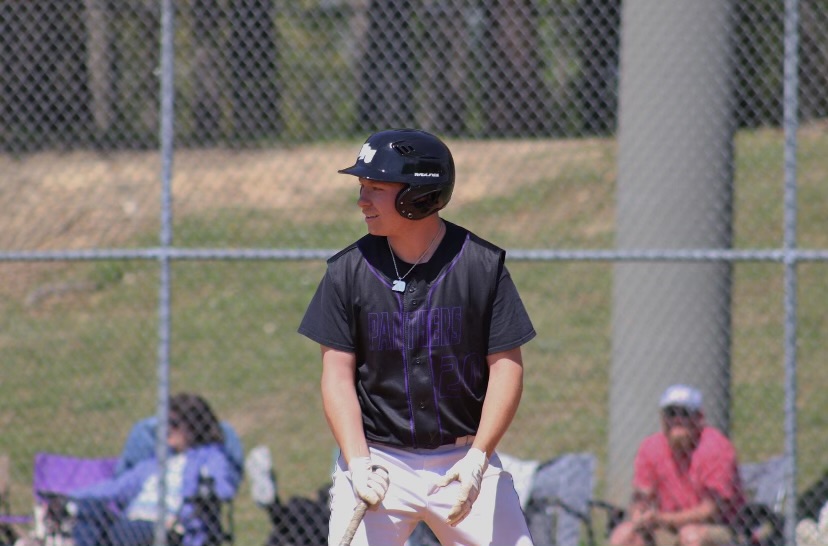
It’s 7:00 p.m. on a Tuesday at the Deep River Recreation Center and energy is abound. The parking lot with around 125 spaces is only a quarter or so filled. There are three different baseball fields, all occupying three distinct groups of sounds rising from each one. One field directly to the left of the lot contains the howls of buzzed adults partaking in some beer league softball. Another contains the sharp, piercing sound of a tennis ball hitting a cricket bat, along with loud thuds of the players footsteps chasing the ball. And finally, just like any other Tuesday or Thursday night, right across from the parking lot, 40 members of the High Point University Club Baseball team are warming up for practice in short left field (which could use a good cut), led by HPU broadcaster and club baseball captain Harris Eisenberg.
Eisenberg is lined up closest to the infield, slowly bellowing out the stretching routine in a thick, scratchy, Long Island accent.
He leads them through the ankle scoops, knee cradles, side-to-sides, knee hugs, high knees, butt- kicks, leg kicks and all the way through until they finish with some sprints.
As players begin to group up to throw, a player mentions some arm tightness he had been dealing with lately.
“Well, sounds like you just have to figure it out,” Eisenberg said.
This is the leader of the High Point University Club Baseball team. If you asked him if he would be here three years ago, he wouldn’t have believed you either.
Growing up on the 1,400 square miles of Long Island, New York’s suburban hub, Eisenberg was well entrenched in the baseball world. He followed the path that many current collegiate club players took: playing t-ball, then little league, then working his way onto some travel teams that played at tournaments like the Cal Ripken Experience and Diamond Nation.
The young and exuberant Eisenberg felt high as a cloud, competing at high levels that he knew he could play at, all while playing the sport he loved so much.
That is, until a run-in with a new coach altered his outlook on the sport entirely.
During his freshman year of high school, Eisenberg was enjoying playing on a local travel team. He was considered one of the team’s key cornerstone players: a first baseman who batted cleanup, while also pitching occasionally as well. This was how Eisenberg saw himself as a player at the time and he believed he was primed for a great year.
However, shortly into the team’s season, there was an unexpected change with the head coach. During the first series of games with the new coach, Harris didn’t play a single inning. After growing increasingly frustrated and feeling a rift forming between him and the new coach, Eisenberg began to feel his perspective on the game altering and his love for the sport waning.
“I remember one practice I was pitching and I was throwing pretty well.” Eisenberg said. “And he asked, ‘Do you even like baseball?’ And I was like, ‘Screw this guy.’ That’s where I really started to question whether I should still be playing. My motivation to play, just because of the specific coach, went down the drain… I was kind of just out of it and said, ‘I don’t need this anymore.’”
So, just like that, Eisenberg’s love for the game that had been so prevalent throughout his young life appeared to be gone. Baseball would not wind up being the prominent fixture in his high school life that it was for the millions of other aspiring young athletes across the country.
However, Eisenberg did not want to let one instance ruin his love for the sports’ environment.
Rather than experiencing the joys that sports can offer by playing the games, he transitioned to becoming the voice that echoed over the game.
After learning that his freshman year English teacher was the head of his high school’s radio station, Eisenberg connected with him about the possibility of broadcasting. After picking up some of the fundamentals, Eisenberg became a prominent fixture at the radio station, calling 3-4 athletic events a year and hosting daily talk shows. Soon enough, Eisenberg began laying the foundation to make broadcasting a career worth pursuing, which took him away from the game of baseball completely.
“When I realized I was going to make that into my legit career, that’s when it was a much easier decision for me to say ‘Hey, figure out your career and put baseball away,'” Eisenberg said. “I thought I had put it away for good. After my freshman year, I didn’t think I would ever play again.”
Over the rest of his high school days, Eisenberg held steadfast in his perspective with baseball, hardly ever picking up a ball and putting the majority of his time and effort into the communication side of sports.
However, once he started getting ready to start college at HPU in the fall of 2018, he began to consider whether he should make another run at playing. This time, for the High Point University Club Baseball team.
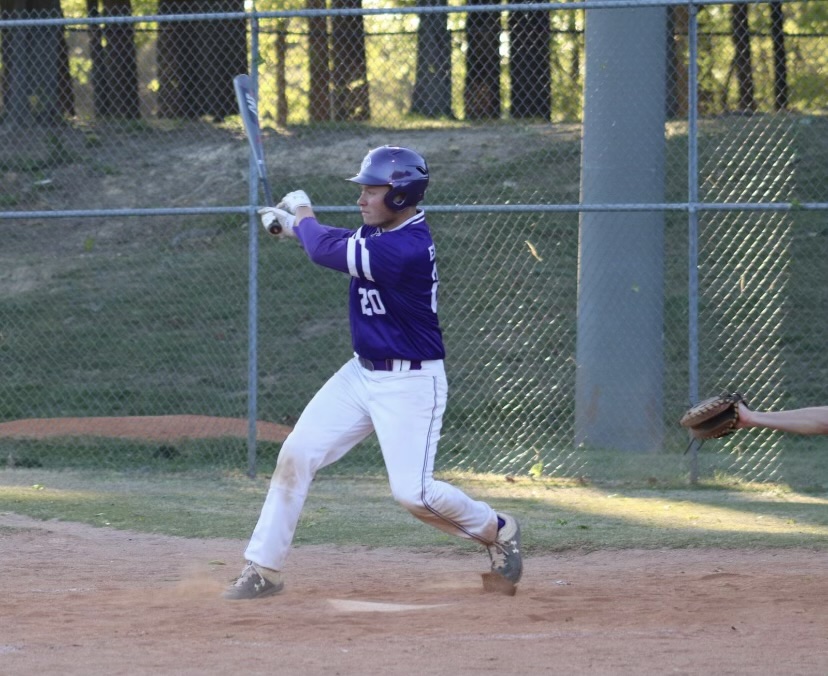
“I went to one of my brothers’ games before I went down, and that’s where it kind of just hit me that I don’t know why I’m not playing still,” Eisenberg said. “I love competing. I thought I still could at the time. So, I said, ‘Let’s make a last-ditch effort to get back in.'”
Club sports are known for offering high schoolers an opportunity to participate in the sport of their choosing without having to commit to the serious time and dedication of a Division 1 sport. Although club baseball offered that nice balance between the time spent with the sport and a social life, Eisenberg was impressed by the competitiveness the team exhibited at the early interest meetings.
“I liked the competitiveness of it,” said Eisenberg. “I’m a competitor.”
Eisenberg was encouraged by the atmosphere that club baseball was offering and was eager to show off what he had to offer, despite being away from the game. However, when he first came to make an impression on the team, he looked like somebody who hadn’t played in three years.
Coming in as a pitcher, he struggled during tryouts with significant command issues. With a lagging, rusty arm that hadn’t been used to the daily grind that wears down pitcher’s arms, Eisenberg was missing locations, spiking fastballs and lacking some stamina. Eisenberg showed that there was plenty of rust that needed to be worn off.
“I wanted to make an impact with the team right away and be able to showcase the skills I still had even after taking three years off,” said Eisenberg. “I remember getting in my head a lot. Just wasn’t able to succeed out of the gate as a pitcher.”
His early struggles were apparent to the head coach, Todd Murphy, a.k.a. Coach Murph, who saw Eisenberg as not a highly fine-tuned player coming into his freshman year, but one who had a lot of potential. Coach Murph thought similarly to Eisenberg and believed most of his troubles were more on the mental side than on his physical ability and skill.
“He was rusty in a lot of areas, but young,” said Murphy. “You could tell the experience level with some of the higher-end kids that come in, but he was definitely young and eager to play, but needed a lot of development to work on. Overall, it was more of a confidence builder and believing he could do the things in his mind that he wanted to do. I think he just put a ton of pressure on himself in the early stages of freshman year, even his sophomore year, because he knew that he could do something and wanted to do it, but he put so much pressure on himself. That’s what caused him to struggle.”
Eisenberg put a lot of emphasis on what Murphy and the rest of the staff were able to do for him. Not just for helping him retool his game, but taking the time to build his confidence back up on the field. Something not many other coaches would have had the patience for.
“Some conversations I had with Murph my freshman year, he could’ve easily told me to go home,” said Eisenberg. “But he believed in me and continued to work with me and thought I had some ability, which I’m thankful for.”
Despite Eisenberg’s struggles with getting the four-year rust out of his system, he managed to impress long-term teammates with his attitude and approach he brought to the field every day, including the co-captain at the time, Greg Allen.
“When I was first getting to know Harris, and I’ve said this to a lot of people, I would rather have a team full of Harris’ than a team of some other people that we had at the time,” said Allen. “That was a guy who wanted to be out there for the sake of being out there… Harris was out there playing baseball because he enjoyed it and wanted to be there.”
Allen, a senior catcher at the time, had played on the club team his previous three years. When he started seeing Eisenberg’s extra work and Long Island attitude translate to more energy for the entire team, he saw somebody who resembled himself in several ways.
“I’ll never forget when Harris was learning how to pitch standing out in the field with the lights on,” Allen said. “This is a guy who wants to do it so bad and is willing to put in the extra work. As somebody who was getting ready to graduate and leave that team, it was nice to know there were people out there that liked it just for the reason of enjoying the game.”
Eisenberg developed a strong camaraderie with the full team, but developed a particularly tight relationship with Allen, who assisted him with the extra one-on-one work through his early struggles. Eisenberg noted Allen as someone who helped him fall back in love with the game.
“Without Greg, I probably would’ve quit,” said Eisenberg. “That guy I’m thankful for every single day. He put up with a lot of the BS of me trying to find my way and he stuck with me and believed in me.”
Over the course of his freshman year, Eisenberg began making considerable strides in his game. After transitioning over from a pitcher to more of a position player role in an outfielder and first baseman, Eisenberg got more comfortable at the plate and was making significantly better contact. However, despite his notable improvements, it did not translate over to playing time in games.
“The kid had a low point that freshman year,” said Murphy. “He felt like he didn’t know what to do, was trying so hard and there were times where it felt like he was almost wanting to give up or take a break because he was struggling so hard. But he had that persistence and desire not only for himself, but he was all there for the team… We just encouraged him not to give up and told him that eventually, one day, things would start clicking for him.”
This persistence mindset that Murphy and the rest of the coaching staff saw in Eisenberg kept him going over the course of his freshman and sophomore years. Eisenberg was with the team when they lost in heartbreaking fashion to Georgia Southern in the Dixie Regional Championship, just two wins off a trip to the NCBA College World Series. Seeing his team advance as far as they did sparked visions in Eisenberg’s mind of the team making a further run in the upcoming years, with himself as a key contributor.
“All I want to do for this team is win,” said Eisenberg. “That’s the mission for the next year… to do whatever I can do to help this team win a championship.”
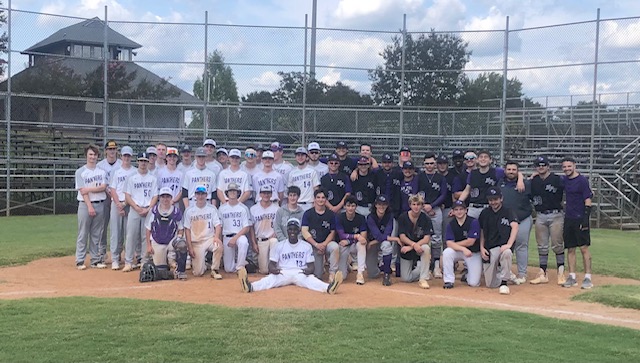
Over the course of the year between the COVID-19 shortened season and the start of his junior year, Eisenberg regrouped and sharpened his game with the hopes of earning the starting first baseman position. Eisenberg wanted to see that all the encouragement and extra work would click for him like Murphy, Allen and others on the team said it would.
The results followed suit.
Eisenberg put it all together during his junior year, putting up a .312 batting average, .450 on base percentage, and 7 RBIs. Halfway through the year, he locked down the starting first baseman spot, achieving his goal to be a key contributor to a winning team.
Unfortunately for Eisenberg, the championship glory he and the rest of the team so coveted weren’t achieved that year, as HPU Club Baseball was kept out of the regional playoff after losing a double-header to Virginia Tech on the following weekend of the regular season.
Although the ending of his breakout year was not what he had intended, Eisenberg’s season did not go unnoticed by those around him. Going from a rotational piece to an everyday starter was no small feat. After watching Eisenberg put in the extra work, bringing much needed additional energy to every club baseball event and finally seeing the results fall into place on the field, Murphy officially named Eisenberg a co-captain of the team. This fully cemented him as a team leader while subsequently achieving a goal that he did not think was possible just a couple years prior.
“He showed enormous ability to be a leader even when he was not a starter,” said Murphy. “He was constantly encouraging other players to pick up their game, was always lively and chirping… He developed into the leadership role and I think he’s earned everyone’s respect on the team.”
Allen could not agree with Coach Murph more.
“I’m so proud,” said Allen. “There’s so many mixed emotions because I wish that I could be there to be a part of his journey more than I have been… You’ve got to leave and open the door for somebody else behind you and it really starts raising the question of legacy… It really makes you think, especially as you leave this place. As a senior, are people going to remember who I am? Did I really make a difference in somebody’s life?”
When reflecting on his collegiate years, Eisenberg is proud of how far he’s come.
“Just being a leader, it comes with the fact that I’ve earned the respect of my teammates,” Eisenberg said. “I earned the trust to go out and say a motivational speech before a big game, talk to players about what they can do because I’ve been in every position. I’ve been a starter and I’ve been a benchwarmer, so I know what every single one of these guys are feeling, so I’m always one to talk and make sure everything is going okay.”
After 2 1/2 hours of infield/outfield practice, base running drills and going over bunt coverages, the HPU Club Baseball team wraps up their Tuesday night practice with conditioning sprints and a mad dash around the bases for each of the 30 or so guys in attendance.
Like any other practice, Coach Murph calls for the team to circle around the pitchers’ mound. In his thick, southern accent, Murph tells the team that they brought some good energy for the night and lays out what they need to work on (defensive communication, in this case). Murph explains the practice plan and schedule for the upcoming week, which features their fall opening series at home against the University of North Carolina at Chapel Hill that upcoming weekend.
After providing some minor information on uniforms and when to arrive at the field for the game, Murph ends practice and lets the boys do their thing.
“Alright fellas, that’s it for tonight,” said Murphy. “Let’s break it down, Harris.”
Eisenberg, a player who might not be the most talented one there, and who just three years prior hadn’t thrown a baseball since his freshman year of high school, steps up onto the mound.
He is not there as a pitcher ready to chuck a fastball by a batter’s swing, but to lead the closing breakdown surrounded by 30 young men who consider him as their leader.
There is not a C on his jersey, but every player there can tell you he doesn’t need one. With his loud, passionate demeanor, Eisenberg concludes the practice.
“A lot of good stuff tonight boys,” said Eisenberg. “Let’s make sure we keep on working, putting in the extra work away from team practices. Let’s control what we can control. Alright, High Point on three.”
The team chants in unison.
“One, two, three, High Point!”
Ben Membrino is a senior at High Point University majoring in Sport Media with a minor in Strategic Communication. For contact inquiries, please email bmembrin@highpoint.edu
 NewsPoint Network