By John Hurrell
Over the past 50 years, Esports has exponentially grown from its humble roots in 1972.
What started as a five person competition to win a year-long subscription to The Rolling Stone magazine has become a venue-filling spectacles for prize pools upwards of ten million dollars.
Esports has taken strides not only as an industry, but as a pastime. Once technology improved and the genre of game switched from Space Invaders to Call of Duty, the legitimacy of starting a business in Esports looked strong.
The players have improved far beyond what many have thought to be possible. Completing games that took years to make in the matter of minutes and hitting frame-perfect inputs have become a daily occurrence.
Despite this, there are some that have the connotation that playing an Esport doesn’t take any skill.
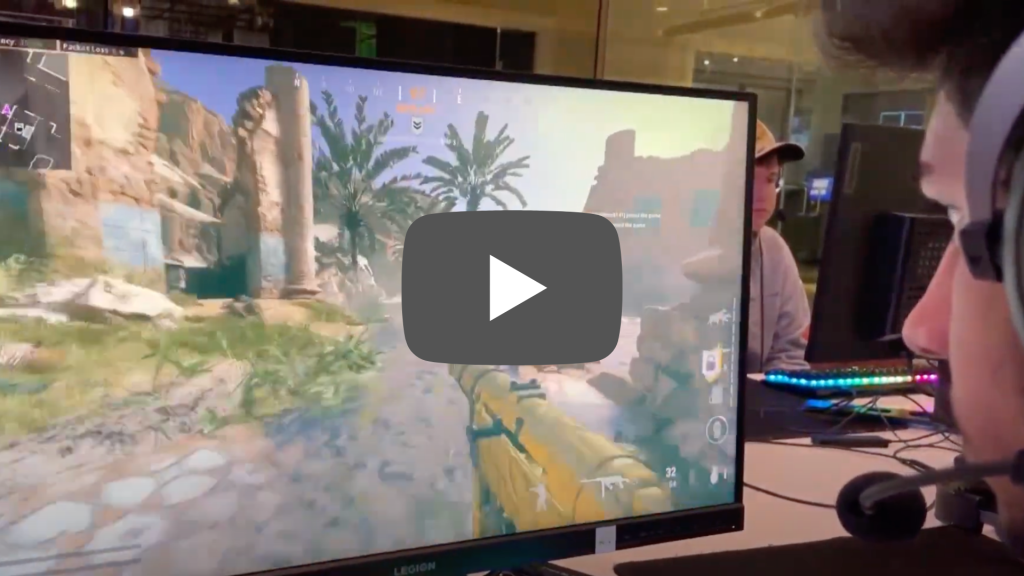
Adam Rahmen, an HPU junior who plays for the University’s CCL team stresses the importance of reaction time in Esports.
“Reaction time is probably the most important aspect of Esports,” said Rahmen. “You can have good game sense and a good grip on mechanics and metas, but if you aren’t able to make a crucial play due to a lack of reaction time, the rest doesn’t matter.”
Reaction time is important to both sports and Esports, so how do the athletes stack up?
From a color cue experiment done by the Ohio Journal of Science, on average Esports competitors had reaction times from 130-220 milliseconds. Football players had reaction times from 300-450 milliseconds. The control group made up of participants had reaction times from 350-500 milliseconds.
Not only are Esports players on average 120 milliseconds ahead of football players, but that small window of time can mean victory or heartbreak.
Mason Kearns, the HPU CCL captain, describes a moment where reaction time was key to victory.
“When Optic Chicago faced the Minnesota ROKKRs last year, Optic had the upper hand in a 3v1 in the final round,” said Kearns. “The three Optic players were lined up and Accuracy (player for the ROKKRs) peaked and eliminated all three. If Accuracy was even a couple milliseconds too late, Optic would have advanced.”
When milliseconds can decide whether you win ten million or go home, the necessity to have a great reaction time rears its head. Aim/Reaction trainers are a normality for most players trying to sharpen their eyes and hand muscles, but the best way to train your skills is to play the game.
“If you aren’t playing your Esport every day and practicing and keeping your muscle memory sharp, in a week’s time your skill has already diminished,” said Rahmen. “It’s the same concept as studying and keeping your mind sharp.”
Esports has grown and budded into a multi-million dollar industry and its players are competing at a higher level than ever before. So, the next time you walk past the Esports arena and see a player practicing, appreciate the moment and reaction time, because not everyone can win ten million dollars in a matter of milliseconds.
For more information on the High Point University Club Esports team follow @hpuclubsports on Instagram.
John Hurrell is a senior at High Point University majoring in Sports Media. For contact inquiries, please email jhurrell@highpoint.edu.
 NewsPoint Network