By Anna Harris
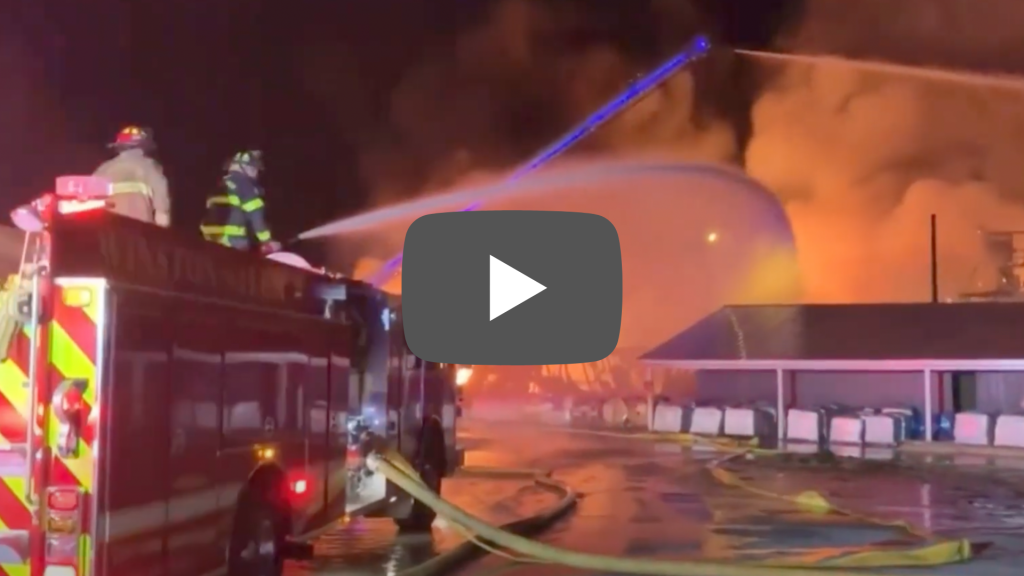
Bright orange flames and clouds of smoke filled the air the night of Monday, Jan. 31 in Winston-Salem, North Carolina due to the Winston Weaver Company Fertilizer Plant fire.
After getting calls starting at 7:00 p.m., the Lewisville Fire Department, Winston-Salem Fire Department and Greensboro Fire Department began to control the flames. The Winston-Salem Fire Department had about 60-70 crew members and were some of the first to arrive on the scene.
“Well, when I first arrived I had to, first, figure out where our water source is going to come from and get as much water as we needed,” said Darius Johnson, an Engineer for the Winston-Salem Fire Department. “The amount of water that I knew was going to potentially flow on that fire. That was the main concern, first.”
On the first night of the fire, WSFD used about 4 to 5 million gallons of water, but the flames still remained.
The main issue that concerned the emergency crew was not the fire itself, but the explosives that were inside the fertilizer plant.
There were about 600 tons of explosive ammonium nitrate located inside the plant that would reach about 6,500 people within a mile radius, if it erupted.
A number of those people were at Wake Forest University, which decided to cancel classes for the following week and urged students to evacuate from their residences.
Sydney Bryan, a sophomore at the university, went home for the rest of the week.
“I think that first night, so Monday night, there was just a lot of panic because no one really knew what was happening and there was a lot on Twitter about it, ” said Bryan. “So, I think there was a lot of panic, but then once things kind of settled down, we understood what was actually going on. It was more like the air wasn’t super clean. So, it was kind of like a ‘Why would you stay?’”
The university is adding two days to the end of their school year to make up for lost time in their academics.
According to the crew at WSFD and their knowledge of fires, they have feared for years that if the plant were to ever catch fire, dangerous things would happen.
However, the Winston Weaver Company Fertilizer Plant never exploded.
Daniel Gossett, a Fire Chief for WSFD, was surprised, yet grateful.
“I have a bunch of friends throughout the country that are real big into hazmat stuff,” said Gossett. “Ya know, they were calling me Tuesday night saying how lucky we were and they would give me the chemical breakdown of it and say, ‘It should have exploded at this temperature and about 20 minutes after y’all arrived and somehow it didn’t.’”
Gossett references an interview that Patrick Grubbs, Battalion Chief, did with WXII 12.
“I think Chief Grubbs said it best in one of his interviews: ‘We don’t rely on luck with our job, but we had luck on our side on that call,” said Gossett.
The fire burned for about four to five days and chemical exposures lasted about eight days.
The investigation on how the fire started is still ongoing.
Anna Harris is a senior at High Point University majoring in Journalism with a double minor in Criminal Justice and Strategic Communication. For contact inquiries, please email aharris6@highpoint.edu.
 NewsPoint Network