By David Kleinchuster
While facing the label of being a food desert and ranking No. 14 in the nation for food insecurity, the caring people in the High Point community get together to discuss ways to address this food deficit.
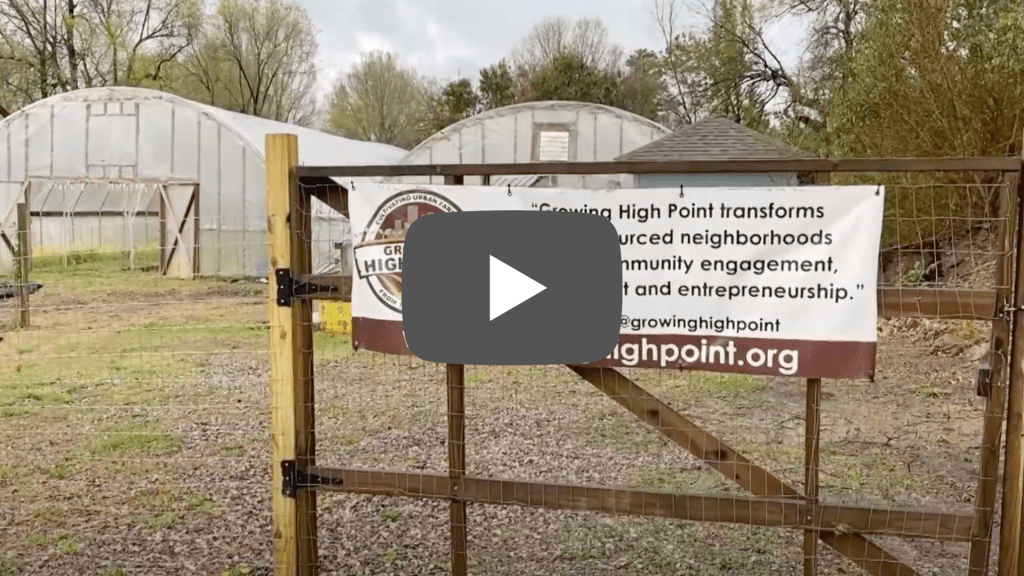
Growing High Point is an organization which prides itself in transforming and connecting its community through engagement and entrepreneurship by the means of community gardens and urban farms.
“I have seen the excellent work that they do in the downtown area bringing fresh produce to a place with a great amount of food insecurities,” said JT Farabow, a High Point native. “Not only does it provide people with healthy, affordable food, but it also creates a sense of community and brings residents of downtown High Point together in a heart-fulfilling way.”
Many high poverty communities surrounding the heart of High Point are considered to be in chronic poverty.
Willa Mays, GHP Executive Coordinator, explains the process of the organization.
“There are a lot of vacant lots, a lot of dilapidated housing and trash in the streets,” said Mays. “We convert vacant lots into community gardens or into urban farms.”
The distinction between the two is that community gardens are constructed of a group of people who are gardening for their own benefit to share with their neighbors and their immediate community, whereas urban farms are an opportunity for individuals to start a small business.
GHP directs its attention to focusing more on the urban farm setting. Through a nine month agricultural season, GHP’s Farm to Table Coordinator, Jose Abreau, trains apprentices which show potential to operate their own farm.
Abreau named the apprenticeship program Farm Fit, where the program aims to equip rising farmers through engaging in the exercises which comes with farming, mental growth and cultivating meaningful conversations in order to unite the community with agriculture.
From owning a supermarket for eight years to now full time with GHP, Abreau introduces an entrepreneurial vision to the apprentice farmers he trains.
“Coming from the grocery industry into the agricultural industry, I had a different perspective than other urban farmers,” said Abreau. “Where most urban farmers were typically local backyard gardening farmers, I took it as a business opportunity to create a model for urban agriculture.”
After the apprentices prove that they are properly equipped, and after acquiring a lot, GHP provides all of the greenhouse infrastructure and water access.
“Everything they grow belongs to them,” said Mays. “They can use it for their own personal benefit and they can sell it. We provide a booth at the farmer’s market so people can take their food there and sell it, or they can have a pop-up food stand of their own community and sell it to their neighbors.”
GHP has four active urban farms currently, and they are looking to expand their food network.
The organization also has its own property, which they farm to accomplish their mission of delivering senior food boxes. These boxes consist of fresh produce on a weekly basis to serve 17 different families for free, and they are looking to expand their outreach.
Additionally, GHP initiated a mobile grocery store called Growdega during the COVID-19 pandemic, which continues to operate and expand its outreach.
“Growdega is a bus, which goes to food deserts in High Point filled with produce and we sell to the communities,” said Mays. “Customers with EBT cards get a 50% discount from us, so they can get an amazing amount of beautiful, fresh produce for very little money.”
Food deserts are areas where it is considered too far for people to walk to the grocery store. Growdega also enables many people in these impoverished communities who do not have access to transportation or those who cannot easily leave their home due to disability. Growdega runs five to six days a week and you can find its schedule online at http://www.growinghighpoint.org.
“There a lot new ideas that we are looking to implement to grow our programs,” said Abreau. “All of this is relatively new, and we are building the plane as we are flying it.”
GHP desires to involve all members of the High Point community, and encourages everyone to come out to support its first urban farm fair this upcoming fall.
“We would love for people in the community to come out and see what we are doing,” said Mays.
Check out Growing High Point for more information on how to enable and equip the future of these urban farmers by reaching the High Point community through urban agriculture.
David Kleinschuster is a senior at High Point University majoring in Journalism and double minoring in Political Science and Military Science. For contact inquiries, please email dkleinsc@highpoint.edu.
 NewsPoint Network