By: Liv Gardner
My favorite type of dirt is the kind that’s like powder. It’s soft and fine, so much so that if it was white, you might think to substitute it for powdered sugar in your grandmother’s next pie. It’s a burnt red, sometimes orange, and the only color you’ll get if you put a shovel in the ground in the state of North Carolina.
It comes with rocks and sticks, maybe even the occasional leaf and bug. I prefer mine without, but unfortunately, dirt is difficult to preorder. The only solutions are rakes and lawnmowers with sections of chain link fences attached to the back. A couple of drags and you get what I call magic. Others call it an infield.
I used to grab it in handfuls, not to mock my morning showers, but rather to dry the trace of the South’s humidity that was left running into my palms. Summer is subjective in North Carolina. Eighty degree days run through October.
The first week of fall 2018 brought red faces and slight droplets of sweat that pooled at the hairlines of the girls tucked tightly into white visors and belted into black jerseys.
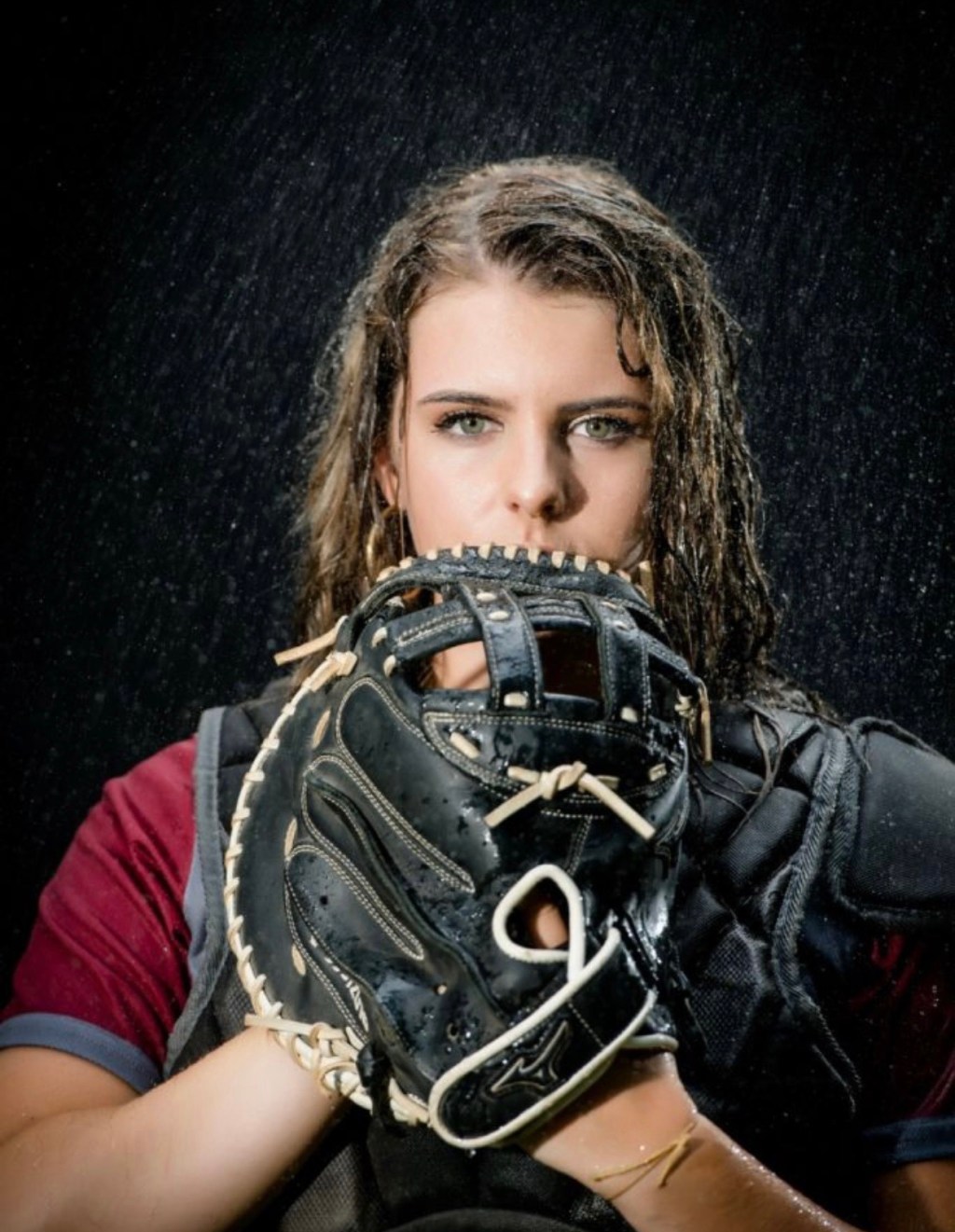
I had a front row view of it all. Squatted behind home plate, I had wrestled through four innings with the mound of excess dirt that had been moved from second base and allocated to the 3 foot by 3 foot box that my position called home.
Picking up as much granulated clay as my palm could hold, I sifted it through my fingers like a funnel, piling it into a nice mountain on my thigh as I waited for three numbers to be signaled to me from the dugout. The first meant nothing, a fake. The second was the location. The third showed the pitch. My job was to pay attention, decode and relay. After catching the numbers from the 300-pound mustached man that consumed the five-gallon bucket he always rested on, I shot a two, three down the center of my squat: a curveball. My mitt, black with white stitching to match my pants, rested at the outside of my left knee to block the signal from being stolen by the third base coach of the opposing team. My pitcher nodded, started her windup and whipped the ball straight into its home with a nice “pop” of my glove and “huh” from the umpire for a strike three. Two outs down, one to go. It was natural for us, a group of girls that were ranked as one of the best teams in the nation.
As a part of the routine, I waited on my knees with the ball, watching as the batter shuffled past me and back to the dugout, always muttering to themselves under their breath. Forty three feet stood between me and the pitcher. Every pitch, every inning, every game I tossed the ball back. It was the easiest throw in the sport of softball. Yet, this time when I went to move, I felt something.
A block. A hesitation. Something different.
Out of nowhere, I spiked the softball into the ground in front of me and watched it roll to the middle of the field. Everyone stared, whispering, combined with my coach yelling “what was that?” as he threw his hands in the air.
I just stood there, frozen in my snow-like mound of dirt, my helmet propped up on my forehead, my glove dangling by my side, confused and unable to move or speak.
“What was that? Why did I do that? God, I hope people weren’t paying attention,” chirped the voice in the back of my mind as I tried to process why I just chucked the ball into the ground like some football player celebrating in the endzone.
Of course, not everyone had seen it. Most of the parents were too consumed by the gossip of the team moms or the pickles wrapped in tin foil that the park’s concession stand provided for just a dollar.
Not everyone noticed the first time it happened, but they did the second time.
Then, the third.
It didn’t happen a fourth time, thankfully. Not because my handful of refined North Carolina soil had settled on my palm just enough to keep the ball from slipping in my sweat and flying back into centerfield, but rather because I was pulled mid-inning and sent trudging back to the dugout.
As I stood against the fence weakly cheering on my teammates, I silently questioned myself like a lawyer looking to catch the other side’s witness in a lie. Yet, I had no answers. I settled on the idea that my hand was sweaty and tried not to think about it as I sat on the bench for the rest of the tournament.
Within two months after that first weekend in October 2018, I lost the ability to throw a softball completely.
***
If you type into Google “Why can’t I throw a softball anymore,” the search engine will spit back at you a series of coaching videos from YouTube on throwing mechanics. If you keep scrolling, the very first article you will find says “How to Overcome the Throwing Yips.”
I can remember rolling my eyes when I first heard the name – the yips. It sounded like the noise your dog made when you accidentally stepped on their foot or maybe even the celebrational cry that Mickey Mouse let out when he gets excited in one of Disney’s cartoon shorts.
Yet, the videos, the player testimonials, the sports psychologists scattered across the internet all returned the same info at the beckoning of my mother’s scroll: a perfect match for what was happening to me.
Eight weeks prior to my discovery, I joined the highest ranked showcase softball team in the state and one of the best ranked teams in the nation. I secured one of three spots at a tryout with more than 75 girls.
Every weekend I traveled to a different city. Rock Hill, South Carolina. Raleigh, North Carolina. Orlando, Florida.
Every Monday night I spent two hours catching fastballs from the team’s star pitcher, a Clemson Softball commit, who threw so hard she left bruises on my palm.
Every Wednesday night I had private lessons for catching, an hour of blocking balls hit at me from across a batting cage, target practice with homemade bullseyes, and flipping tractor tires to stay in shape.
Every Thursday night I drove an hour and a half to my coach’s house for batting practice after a seven-hour school day and two-hour swim practice
I put in the work. I put in the time. I put in the effort.
So, why?
Why was this happening after everything I had sacrificed?
Why me?
Unfortunately, Google’s expertise was limited to a general diagnosis and answering universal questions were much above the search engine’s pay grade. Yet, I was determined to do whatever was necessary to find a cure for the disease I didn’t understand.
***
My feet crunched into the almost frozen snow as I hopped out of the passenger seat of my dad’s red Chevrolet Avalanche, a stark contrast to the white that surrounded us. To my left stood a mailbox, a small wooden sign hanging below it that read “Alternative Wellness and Beyond.” To my right, a house built into the side of Beech Mountain, North Carolina with a pathway to the door lined by stones and figurines.
Carefully maneuvering the walkway so I wouldn’t slip, I approached the front stoop. Two firm knocks were met with a swinging door, a loud welcome, and a goldendoodle.
.
“Polly Humphreys,” said the aged woman that stood before me, hand outstretched.
I shook it firmly and followed her dark bouncing curls into a room just past the door. She sat me down in front of her desk cluttered with stacks of paper and with a heaving sigh, plopped herself in front of me.
“Well, Ms. Olivia, I hear you are having a bit of a mental block in softball. Let me tell you how I can help you,” said Polly.
I’m not sure what I assumed seeing a sports psychologist would be like, but listening to someone pitch themselves to a hurting and confused teenage girl who had driven over two hours for therapy was not exactly what I had in mind. But I was desperate for answers. So, I stayed.
Every week I would Facetime Polly and once a month I would make the drive back up the mountain to undergo her eccentric form of healing.
Her first prescription was a thin, purple rubberband. I wore it on my wrist 24 hours a day. It never came off. Every time I had an anxious thought, every time I hesitated throwing the ball, every time I felt a wave of trembles, every time I began to overthink, I had to snap the rubber band. It hurt, but that was the point. I had to train my brain not to do what Polly had deemed as both my asset and my downfall: thinking. I snapped the band for weeks, leaving welts and small bruises lining my wrist. Yet, nothing got better.
Polly then turned to hypnotherapy, placing me in her dark leather chair that was built to naturally recline and attempting to put me into a “deep sleep” while I “focused on her voice and my breathing.” I never believed in hypnotism or that someone could actually be hypnotized. Maybe that’s why her later sessions also failed.
By late December, I was tired of fighting. My mind and my body were exhausted. So, I stopped.
I didn’t pick up a softball. I didn’t meet with Polly. I didn’t go to the winter practices that my teammates attended weekly. Most of all, I didn’t talk about it – to anyone.
***
The yips is a silent killer. There is no true cure. There are no trained professionals that can tell with certainty where it originates. There are no predictors of when it may end or when it could come back.
The Mayo Clinic argues it comes from anxiety and self hyperfixation, while researchers in psychology at the Human Science Research Centers cite perfectionism and fear of negative evaluation as the root of the issue.
While the term “yips” was first used in the game of golf, it was quickly adopted by other sports as the phenomenon struck athletes in baseball, softball, cricket and even darts. The Mayo Clinic contends that the block was always renamed “performance anxiety” in common use, but more recently, doctors have found that it can be an actual “neurological condition affecting specific muscles.”
There are always suggestions from therapists and online resources about what may cure the yips. The difficult truth is that the same thing rarely works twice. I found out the hard way that just because a solution worked for someone else doesn’t mean it is going to mend all of my problems.
The main contributor to improvement for me was isolation. I needed time away from the game both mentally and physically.
***
Being an only child means that every ounce of focus that your parents have goes straight to you. Being an only child with an issue that is ruining your life and affecting everyone around you makes that focus grow exponentially.
Every night questions filled my plate during family dinners, leaving me to choke down the worry that tried to force its way up when someone uttered the words “softball” or “the yips.”
While every ounce of me wanted to get out what I was dealing with, I couldn’t handle the anxiety that came with even thinking about picking up a ball, let alone stepping onto a field. I watched as it not only tore me apart, but as it slowly took my parents too.
By the end of 2018, conversation in the Gardner household was sparse. One might ask about another’s day or talk about work and the weather, leaving the rest of the time together to be filled with awkward silence and updates from the local news.
My mom and I learned to make small talk, but my dad and I hardly spoke. I knew it was just as hard for him to talk about it as it was for me. My mother would always say that he had hope, but as time passed, I doubted everything.
The one thing that had brought us together our entire lives was now ripping us apart. Grass was growing through the turf of the batting cage that he built for me, a place we had practiced in daily. Our gloves sat untouched in the trunk of my car. We stuck to our respective sides of the house, separated by a tension that was weighing us both down.
It seemed as if this was the new reality for us all, a reality no one wanted to be in, but one that was impossible to escape.
***
Five months after the war with myself began, I finally found a glimpse of hope: someone else who had the yips.
Kody Thomas was two years older than me and a catcher at a high school two towns over from where I lived. He not only had gone through exactly what I was experiencing, but he had beaten it.
“I was relieved when I heard you had the yips,” said Thomas. “I wasn’t necessarily surprised that I was asked to help coach you through it, but more relieved that there was someone else that had it, not just me.”
Thomas changed the way I saw my condition completely. He explained that it was not something that just affected baseball and softball players, but he had found golfers, gymnasts, and other athletes who all had the same type of mental block.
In our first time working together, Thomas shared a piece of advice that shifted my perspective for the better.
“Stop caring what other people think. Just stop caring period,” said Thomas.
For months, I had felt useless. Whether I was in class or about to step onto the field, I thought about being a burden. I worried about taking up a roster spot on such an elite team and whether or not the coaches that took the chance on me four months before were now regretting their decision. I anticipated what comments I would hear from the family members that filled the stands, sometimes even from the umpires on the field. I felt embarrassed, not just for myself, but for my mom and dad who had to explain to the other parents that I was still struggling. I was ashamed of the looks I got from the college coaches that I had worked with, the ones who once considered giving me a shot. I felt like a zoo animal that everyone had bought a ticket to see, trapped in a glass cage while everyone pointed fingers, laughed, made comments and took pictures.
After hearing Thomas’ advice, I knew I not only needed to take it, I had to. The burden of carrying my own shame and the constant fear of what others would think of me was killing me. My relationship with my family was suffering. My days were filled with thoughts of dread for the tournament of the coming weekend. My grades were slipping. My mind was in a constant state of worry.
My only option was to stop caring. So, I did.
In late March 2019, with the support of Thomas and my parents, I stepped onto a softball field for the first time in over six months.
I tuned out my coaches, the whispers of the fans in the stands behind me, the comments made by teammates when it took me longer than usual to release the ball, the jokes made by the other coaches mid-game, and most importantly, myself.
***
If I pick up a pair of my old softball socks, ones that have been sent through the wash countless times, I still find traces of the red dirt stuck to the threads. The little pieces of my past tucked everywhere, still a part of me refusing to leave.
I drive past the fields of red that once felt like home and now see leveled lots that house the memories of what I once was. I watch the girls I used to know, tucked into white visors with red faces and sweat beading at their hairlines, a front row view from my couch as they dart across the television screen in my living room. I watch them take signs from new catchers, whipping their pitches into different gloves.
I think about the past, the what ifs, the could have beens, and where I am now. I talk to my parents about who I was, remembering record stats and game winning plays. I carry the guilt daily of the money, time, and support lost by my mom and dad from a career that ended too soon.
Then, I remember I didn’t quit.
I remember that I still play.
I remember that in the end, I won the battle.
 NewsPoint Network