By: Alex Powell
Standing inside the 400-meter track, Aidan Britt was sweating just as the June sunshine
beat down on the stadium. As he completed his last-minute stretches, he kept his eyes focused on the starting line only a couple feet away.
POW!
The starter’s gun fired loudly nearby to signal the beginning of the Massachusetts
Interscholastic Athletic Association’s men’s 4×400 meter state championship relay race. Aidan’s brother Ryan was running the relay’s first leg and had gotten off to a good start in lane one.
As he came around to finish his lap, Ryan was in the lead and handed the baton off to his
teammate Nick Rinaldi. Nick then gave the baton to Luke Loeffler for the third leg. As this
exchange occurred, Aidan made his way to his spot in lane one.
As Luke came around the last corner, he was in second place, but Aidan knew if Luke
could maintain that position, they would have a good chance to win. The handoff was clean, and Aidan was clear of the exchange area. The other schools had no chance.
Aidan was in first by the end of the first 100 meters. As he entered the back straightaway,
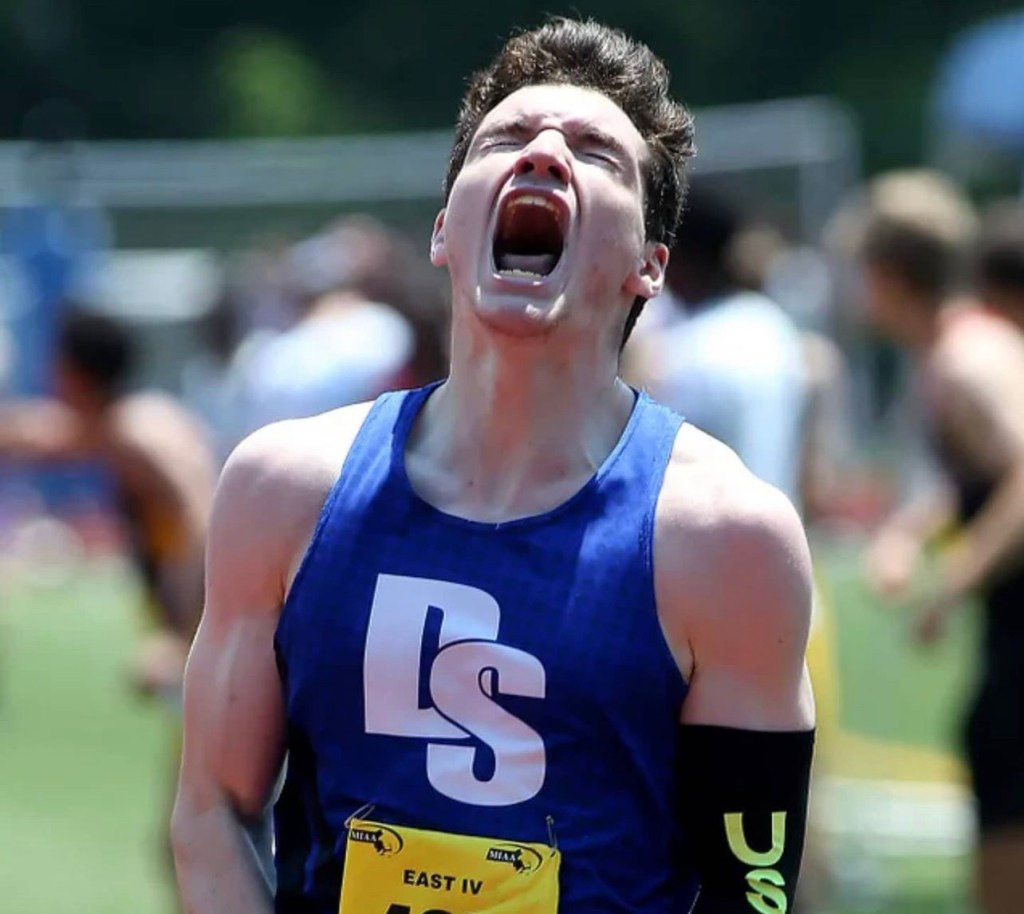
Aidan kept putting distance between himself and his competitors. When he came around the last corner, he knew they were going to win and kept pushing to the finish. After crossing the line, Aidan screamed out of joy for officially being recognized as the best 4×400 relay team in the state of Massachusetts.
This ended up being Aidan’s last high school track event, and it was special for him not
just because of the win, but also being able to do it with his brother.
“I say it a lot, but running with my brother, that was special,” said Aidan. “We were one
of the fastest teams the nation; our team won two state titles.”
From lying in the hospital basically unable to move and having spinal column tests to
state champion, Aidan could look back and marvel at the progress he made over a short two-year period.
“My childhood was very weird. I was a weird kid,” said Aidan. “I was friends with like
the middle friend group, not the coolest kids in school and not the nerdiest kids in school. There’s not that many people like that. Around my sophomore year, I burned those bridges with everyone in my friend group.”
Those bridges were burnt by small and petty reasons such as an unpopular girlfriend and
quiet nature. This loss of friends in his sophomore year sent Aidan into a downward spiral in
high school.
“The rest of high school I was just alone. I would usually not go to class,” said Aidan.
“There was an empty classroom, and I would just sit there all day. I would get marked present for being in school. I just wouldn’t be in class, so I started falling behind so much that I was on a trajectory not to graduate.”
The empty classroom was the DS Bridge program at his high school that helps transition
students through difficult times physically, emotionally or academically to their full potential.
The Dover-Sherborn High School website says this about the program:
“DS Bridge serves students with both social-emotional needs and medical
absences who need support in navigating a return to school after an extended absence. DS Bridge will always accept a student who has been absent while receiving inpatient, acute, residential or day psychiatric services.”
The program allowed certain students to leave class at any given moment to go to Bridge
to get support and help when needed. Aidan used this resource because he was struggling with serious anxiety due to the lack of a social life and his desire to fit in.
“It could be the smallest thing. I just didn’t know how to deal with anything,” said Aidan.
“[It progressed] Until I couldn’t walk. I couldn’t move. I didn’t want to leave the basement. I
couldn’t go to class because I did not know how to deal with it.”
The anxiety was a long time coming as things just piled on and his parents were
concerned about his condition’s development.
“We felt terrible that we were not able to diagnose the problem earlier and that Aidan was
going through so much pain,” said Thomas. “It was really scary when he would have an attack, he would lose consciousness and then have difficulty speaking.”
Before he got into a better place mentally, he was medically treated numerous times
including two ambulance visits and four hospital trips because of debilitating anxiety.
One of the hospital trips was an overnight trip that occurred at the beginning of his junior
year of high school. Since this was at the height of his anxiety, the panic attack was simply
triggered by sitting in a full car. The onset of the attack started with numbness in his feet that trickled upwards until he could not move his body, could not coherently talk and could barely breathe.
“I had a panic attack and I ended up going to the hospital for three days,” said Aidan.
“They drilled holes in my back because they’re like, ‘There must be something up with you
because you can’t move. You can’t talk. You can’t walk, you must have something wrong with
your nervous system.’”
The holes that Aidan referred to are part of a procedure called a lumbar puncture. According to John Hopkins Medicine, the procedure is when a doctor inserts a hollow needle into the space surrounding the spinal cord to remove cerebrospinal fluid for testing or to inject
medicine. Aidan still has a scar from the needle insertion point, but physically recovered after a few days of walking difficulties.
There was nothing wrong with Aidan’s nervous system. The cerebrospinal fluid that was
removed and later brain scans showed no physical ailments, so the diagnosis was a panic
disorder and agoraphobia. According to the Mayo Clinic, agoraphobia is a fear that leads people to avoid spaces or situations that could cause panic and make them feel trapped, embarrassed or helpless.
The anxiety had reached a tipping point, and as a result Aidan attended therapy five days
a week for six months to try to help overcome it.
The therapy helped Aidan to understand why he had his anxiety, but it was not all green
pastures after it ended.
“It went from hell to nothing,” said Aidan. “I don’t get anxiety anymore, [that’s] good
and bad. Like I don’t get nervous when I should…Instead of having big jumps of being happy
and sad, [now] I am just neutral.”
The anxiety and agoraphobia are still present at times, but it has taken a backseat partly
because Aidan has used track as a new coping method.
“I always loved track growing up. I ran sprints at recess in elementary school, but I
couldn’t do track until my freshman year of high school. I always knew I was fast though,” said Aidan.
Aidan ran track his freshman year of high school and was not as competitive as he would
have liked, but at that point hockey was still his focus. In his sophomore year, he took more of an interest in track and finished eighth in the state in the men’s 400-meter race. Aidan still desired more success and when he quit hockey that gave him more time to put into track.
Unfortunately, his junior year was affected by the COVID-19 pandemic, but he still
found a way to train and race.
“We would do secret indoor meets, all the top runners in the state we would all connect
and meet at an indoor track at Wheaton College,” said Aidan. “We’d all run in masks with the
doors open secretly because it was not sanctioned.
“So, we could not wear anything from our school. We would just wear t-shirts. We all ran
and that was our indoor season. And I broke the school record in the 300 for our school,” said Aidan.
That 300 record came in at 36.98 seconds, and Aidan attributes that time as the main
reason he was able to run track in college because most colleges recruit based off junior year
times.
By the end of his high school track career, Aidan had the fastest time in the 300 and 600,
second fastest time in the 400 and 200, and a part of all the relay records in the school history.
Being a part of track helped create a bond that helped him get better physically and
mentally.
“There were setbacks and Aidan wasn’t ‘all in’ at first, but over time it all came together
for him to get to a better place than he was before,” said Thomas. “[He] got a lot of support from his teammates and coaches that really helped him.”
The graduation requirement for Dover-Sherborn High School is a 2.0 GPA. Aidan
graduated high school with a 2.0 GPA.
After graduation, Aidan moved down to High Point University in Fall 2021 for his
freshman year. He is currently majoring in business administration with minors in sales and
marketing.
Restarting academically was an ideal situation for Aidan as he aims to be on the dean’s
list every semester from now on, but that is a difficult task as he is running track at HPU. He has a busy schedule of attending class in the mornings and going to practice for up to four hours in the afternoon leaving little time for homework, but he wants to prove to himself he can succeed.
Last season, Aidan started out the season strong by running a personal record and
winning the 400 at the intra-team meet in the preseason. After that, things went downhill. He
hurt his foot and never let it rest because he had no idea how bad it was.
It eventually got so bad that he had to end his season, but part of that was also for
personal reasons. Around the same time, Aidan’s best friend from Massachusetts died in a car crash. The effect of his friend’s death had a profound impact.
“It hit him hard due to the fact he had not seen him because he was away at High Point,”
said Thomas. “I think for the first time it made Aidan realize that he is not indestructible, and it could happen to him or other loved ones or friends.”
The loss of his friend also made Aidan temporarily lose his drive to competitively run.
“Every time I did a warmup, I would just start bawling my eyes out. I couldn’t run. I
didn’t run a race after that,” said Aidan. “That was the last meet I went to last year and that was it for the year. I just shut it down.”
After going home for the summer, Aidan went to the doctor and was told he had bunions
in his foot. He got a brace, new shoes, adjusted his weightlifting form and changed his running form. He has since not had any pain in his foot. The lack of pain has helped him continue training for track and put on 20 pounds of muscle over the summer leading to high personal expectations.
“It sounds weird but if it isn’t this year, I don’t know when it is,” said Aidan. “I’m not
weak anymore. I’m not out of shape. I’m eating right. There’s no excuse for me not to be running well this year.”
With just under three years left of his college career, he aims to make huge athletic
strides moving forward because he wants to run track or Olympic weightlift professionally for Ireland. But if that does not work out, he aims to work in business.
“He knows how to stay humble by letting his actions speak louder than his words,” said
Aidan’s friend Stefen Shapiro. “I can see Aidan easily excelling in a business administration job in large market areas like Charlotte or Boston.”
While Aidan has gone through a lot, much of it admittedly self-inflicted, he sees that he
has made mental and physical progress to get where he is now. He values the progress by trying to make the most out of every day. This includes doing fun activities, being with people he likes and only worrying about what he can control. If he does not take his own advice on these topics, he considers them to be regrets and he constantly aims to avoid those regrets.
“[I want to] go to bed without regret. You regret a lot of things you do throughout the
day,” said Aidan. “If I can do that just one time, then I’ll be fine. If I do that more than once, each time will be better than the previous because long-term happiness is better than short-term happiness.”
 NewsPoint Network