By: Riley Manion
The only thing louder than the sirens coming from the approaching ambulance were my mother’s screams. Sitting in a patch of barely grown grass on the side of a nearly empty highway, my brother sat with his knees up, so I had something to keep me up and conscious. I leaned against his propped legs as a random woman took a white envelope out of her blood red purse and began fanning me with it.
Almost 30 people surrounded me, but it felt like I was the only one there. I have never felt so much pain yet felt nothing at the same time. What started out as an incredible family trip to a foreign country turned into a near death experience that I never thought could happen. Especially not to me. It would never happen to me…until it did.
***
The night started out as one of the best nights of the trip. We were celebrating my older brother Brady’s 18th birthday and a popular thing to do when you celebrate a birthday in Medellin, Columbia is to rent out a party bus. My 16-year-old self was quite jealous that he got to spend his birthday travelling the streets of the city while the most popular Latin songs pumped through our veins.
Colombia doesn’t sound like the most appealing trip for a family vacation. My family and I were all hesitant at first. My uncle was planning this trip for us, as his boyfriend was from Colombia. He thought it would be an exciting, adventurous trip to explore another country. And the fact that we didn’t have to spend money on a hotel, because his boyfriend’s family still lived there, was a huge selling point. So, we took the jump and went on the trip.
We didn’t want to seem like huge tourists, being we were staying with a Colombian family. But, as we got on the party bus, we all put on our new cream-colored knit ponchos that had “Colombia” embroidered into it in big, green letters. Looking back, it made us look like the most cliché tourists ever, but they came in handy later that night when it was the only thing I could use as a pillow on the hour and a half trip to the nearest hospital.
As we all poured onto the party bus, we could barely hear ourselves think over the floor-shaking all Spanish version of “Despacito”. The moment we stepped foot onto the bus, the hostess on the bus forced a shot glass into all our hands and to this day, I couldn’t tell you what was in it.
“Estoy Diez y Seis” I said, in the best possible Spanish accent I could. It was my best effort of trying to say “I’m 16” in Spanish, but it didn’t really land. She shook her head no and opened my hand for me, forcing me to hold it. And then she locked eyes with me, not in a threatening way, but rather with a little smirk, and watched me until I poured the shot down my throat.
Flashing colorful lights flooded not only the party bus, but the entirety of the dark street as we set off on our trip. While we were celebrating my brother’s birthday, my family and I only knew each other, and everyone else were strangers. But none of them acted like that.
I sat there uncomfortable and too embarrassed to dance, but that didn’t stop the professional dancers they hired on the bus to come pull me off the wooden bench and teach me how to salsa. There was barely any room to dance, but we all somehow managed to put on full salsa routines to every song that came on.
As soon as it turned midnight, we reached our halfway point on the trip and “Happy Birthday” started blasting in Spanish over the speakers in the party bus. At this point, everyone was comfortable and having the best time, dancing in the 90-degree heat of the late night in Colombia.
An hour into the trip, it was time for our bathroom stop. The energy of the bus was so positive, and everyone was laughing and having fun. We all spilled off the bus as we continued to dance to the music.
Getting to the bathroom seemed simple – all we had to do was walk across the empty suburban street and into the building with the bathrooms. But the empty suburban street was actually a three-lane highway with a 70 mile per hour speed limit.
The last thing I remember about this moment was telling my mom how fun it was learning how to salsa dance in Colombia. The next thing I remember was getting up off the concrete floor looking around in confusion as my mom, dad, and two brothers screamed running towards me in fear that they were about to lose their son.
When I finally snapped back into full consciousness, I realized what had happened. As my brothers lifted me up and brought me to the side of the road, I saw a man getting up next to a motorcycle on the floor. And that’s when I realized what happened. I was hit by a motorcycle.
***
Motorcycles are one of the most common ways of transportation in Colombia. According to a research study on vehicle fleets in Colombia, conducted by Statista, over 50% of vehicles in the country are motorcycles classifying them as the leading vehicle type.
Whether it be a one lane road or a three-lane highway, drivers of motorcycles create their own lanes, weaving in and out of traffic to get to where they need to be in the fastest way possible, with complete disregard to the law.
This was something that I noticed my first few days in Colombia. I remember telling my parents that I thought it was crazy how reckless the motorcycle drivers were and how there were so many of them. But I didn’t realize how pivotal of a role they’d play in my trip.
***
From what I remember happening before and after passing out, as well as what my family members told me, I am lucky that I’m still alive today. The man driving the motorcycle was driving 70 mph down the highway when he hit me. I never thought I’d be able to say that my mom’s butt saved my life, but if it weren’t for the motorcycle’s handlebars hitting her butt, making it turn, I would’ve been hit head on and would have been dead on impact.
The motorcycle was a deep royal blue that looked like it had just come off the lot. The only thing that made it look old was the missing wheel covering that came off after I was hit.
As soon as I was hit, I blacked out. I didn’t feel a thing as my body rolled nearly three yards from the initial impact. When I regained consciousness, I looked down at my knees to see blood slowing dripping down my leg. I got up and tried to take a step but collapsed into my brother’s arms.
The man immediately went up to the driver of the party bus and asked if he was able to leave. He got met with a harsh denial as the driver began questioning him, asking if he was drunk, amongst many other things.
Forty-five minutes went by after we called the police, and the ambulance still hadn’t shown up. At this point, I began to feel the pain pulsate through my legs.
***
The average response time for an ambulance in America is just five minutes. Statistics state that the average response time for Colombia is three times that at nearly 15 minutes. I was unfortunate for it to be nearly 10 times America’s average, however that revealed a lot to me about Colombia’s healthcare system in comparison to the United States.
A huge difference between America and Colombia’s healthcare systems though, came in the form of the type of vehicle doing the transportation to the hospital. No matter the type of call or when the call is made, in America, an ambulance is sent to the scene. In Colombia, a pick-up truck was sent to transport me to the hospital.
Not only did this come as a shock to me, but it also shocks many people that have moved from America to Colombia as well. In an article published by EMSWorld, it states the fire and EMS services are drastically different in Colombia from what Americans expect. “They respond to emergencies but contract out to transport patients by ambulance. They don’t have the response-time standards like we do. They’ll get there when they get there.”
***
Hesitantly, I hobbled into the back of the pick-up truck that was sent in place of an ambulance. My mom and dad sat with me, with my mom still crying 45 minutes after the accident. I knew that I had probably broken my leg, but I thought I might have a broken hand after this ride to the hospital because of how hard my mom was squeezing it.
I thought I would have been at the hospital within 10 minutes after they picked me up, hoping they would speed through traffic with their lights and sirens on. But I was certainly mistaken.
It took us just over an hour to get to the hospital as the driver casually rolled through the city, even bopping his head to the music playing. I don’t know how he even heard it over my mom’s crying.
The hospital looked closed or even abandoned. One flickering light hung above the entrance door that was being blocked by a nearly 6-foot-tall security guard. The police officer helped me out of the back of the truck and put me in a wheelchair, only to go up to the door for it to be locked. The security guard yanked at the handle, but it still didn’t open.
For nearly two minutes he pounded on the door trying to get someone inside to open it. “What kind of emergency room has their doors locked,” my mom said in frustration to the officer. We finally were let in by a patient in the waiting room, who looked like they hadn’t slept in two weeks.
***
Colombian healthcare and the concerns many people have with it are connected to the treatment of hospital workers as well as their low pay. According to research performed by Colombian doctor, Stella Quintana, hospital workers lack motivation which in turn denies patients the proper needs for their situations.
Cost-efficient solutions are the main priority, rather than what may actually be needed, whereas in America, patients are typically given treatment that will actually fix whatever may be going on.
This specifically comes into effect when there is a language barrier present between the patient and the staff. In a separate study conducted by BMC Public Health, surrounding Healthcare access barriers in Colombia, it states “Significant barriers were related to a lack of resources in rural areas, limited knowledge of the Colombian health system, the health insurance program, perceived stigma, and transition process from the FARC health system.”
The limited knowledge regarding Colombian healthcare combined with the language barrier seems to be a recipe for disaster for anyone travelling from America to Colombia.
Thankfully, my uncle’s boyfriend, who was originally from Colombia, was there with me and my parents to serve as a translator between us and the hospital staff. We sat in the waiting room for nearly two hours before they took me in for a physical therapy evaluation.
“Nothing’s broken,” the nurse said, after testing the bendability of my leg. “We still need to take X-Rays for procedure purposes, but you’re probably just feeling pain from the trauma of the accident.” Of course, I was a little hesitant of this. There was no way I left being hit by a motorcycle going 75 miles per hour unscathed. And I was right.
***
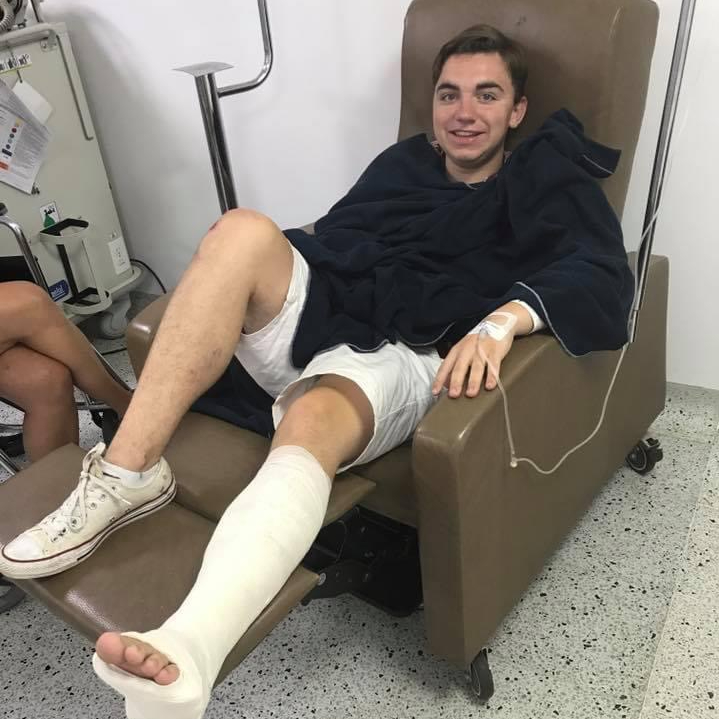
“So…it turns out you have a broken tibia…and fibula,” the nurse said, as he hesitantly walked back into the waiting room. “We’re going to take you back for an IV drip and to wrap up your leg. You can follow me.”
My dad pushed me in the wheelchair behind the nurse as my mom and my uncle’s boyfriend both talked to the woman at the front desk, trying to figure everything out.
At this point, I knew that I had really taken for granted our healthcare system back home. But it wasn’t until this very moment that it really solidified it. We got to the room where I was supposed to get the IV, and all it was, was a small room with six light brown leather chairs lined up in a row, each one more worn than the next.
“Have a seat right here…oh sorry let me clean that up first,” the nurse said. I looked down to see him wiping up blood off the seat with a paper towel. It felt like my stomach was turning upside down.
“Can he just stay in the wheelchair?” my dad asked. The nurse then proceeded to shake his head no and motioned me to sit in the chair.
Thankfully, my dad had a leftover handwipe that they give at some restaurants in his pocket. He wiped the seat again before I sat down.
For the next two hours, I sat there and received the slowest IV drip to ever exist. It was now nearly 4am at this point, and my parents were both dozing to sleep.
The doctor finally came in and wrapped my leg in a splint, gave me a worn-down pair of crutches, and sent me on my way.
***
I never thought I would’ve been run over by a motorcycle, let alone in a foreign country. I don’t want to say the rest of our vacation was ruined, but when the rest of our plans consisted of climbing a mountain and ziplining over the city, it’s easy to say the fun got cut short.
When I got back home, I went straight to the hospital. The splint had been on for nearly a week at this point when they are only supposed to be on for a few days. My doctor had put me in a walking boot, prescribed me pain medications and told me a realistic recovery time of six weeks. In Colombia, all I had was the Advil bottle my mom brought to get me through the pain, so having real pain medications helped tremendously.
For the next month and a half following the accident I did some healing both physically and mentally. Getting hit by a motorcycle was a traumatic experience, but it helped me to realize how many things I take for granted living in the United States, and perhaps one of the biggest things is my access to reasonable healthcare.
In America, it would be unheard of to wait 45 minutes for an ambulance. Or to have to bang on the hospital door to get in. Or to wipe another patient’s blood off the seat with a restaurant wipe.
All this aside, I would never change this experience. I learned a lot from it. Whether it was my high school Spanish skills trying to come into effect, or me realizing how lucky I have it back home, I learned that no matter how hard life hits you, Colombian motorcycles always hit harder.
 NewsPoint Network